Auteur Theory from clwp_cloe06
Wednesday, 26 September 2012

Wednesday, 12 September 2012
"Super Bass" Video Analysis
The song “Super Bass” by America female recording artist
Nicki Minaj was released on the 5th April 2011. It is from her
deluxe edition of her album Pink Friday and comes under the music genre’s of R’n’B,
Pop and Hip Hop. It was produced by Kane Beatz and JMIKE and is under the
record labels of young money, cash money and Universal Motown.

 These are not only technical codes but they conform to the
genre conventions of an R’n’B/Hip Hop music video where males or females are
usually dressed provocatively in order to attract the audience watching. This
could also be seen as a symbolic code as the men used within a video of this
genre are always either very muscular and the women are always extremely curvy
with large assets.
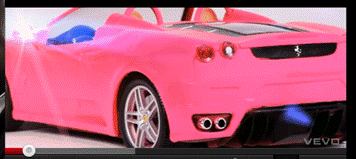 Another genre convention of this music is the fact that
money and expensive things such as cars appear. However this is also a symbolic
code as the expensive car is pink and so is the hair colour of Nicki Minaj and
her dancers and many other elements in her video. This connotes the idea of
feminism and the specifically idea of Barbie. As Nicki Minaj also refers to
herself as the “Harajuku Barbie” this could be a way of putting that across
within her music video.
 The idea of feminism with in the video is also a
symbolic code itself as Nicki Minaj challenges gender stereotypes in this video
because she is doing things to the male like touching him and showing a more
dominant side towards him. In one of the scenes she is seen to be throwing
water at the male from a pink cup which is very symbolic as the pink connotes
feminism however the throwing of the water shows a more aggressive female. Aggression
is a personality trait which males are said to have whilst females are meant to
be more motherly and caring and so this definitely goes against that.
 Many common conventions of music videos are used such as
fast edits, the video is the same length as the actual song and also the artist
is presented as though she is singing along to the song and so performing for
the audience. The genre convention used which would fit a Pop video is the fact
that there is a lot of performing especially through synchronized dancing
however the artist is the main dancer.
Friday, 7 September 2012
Wednesday, 5 September 2012
Codes
Codes are a system of signs which create meaning. This may include technical codes or symbolic codes.
Symbolic codes show what is beneath the surface of what we see. The video for "Take Care" by Drake ft Rihanna has many symbolic codes which can relate back to his personal life and the lyrics of the song. The bull in the video represents the Taurus star sign which is what Rihanna ex boyfriend Chris Brown was and the fish represents the Pisces start sign which is what Rihanna is. Chris Brown and Rihanna broke up due to abusive reasons and through out the video Drake is embracing her which relates back to the song and could be seen as him "taking care" of her.
Technical codes are ways which equipment is used to tell the story in a media text. This can inclue the camera work specifically the movement, angle and shot distance of the camera. Close ups are a very common form of camera shot to use as it helps the audience to recognize the artist. In real life no one will ever be as close to a person as the close up shot is unless they have a very close and intimate relationship with that person. A close up shot helps to create that itimacy for the audience. This can be seen in the Take That "Back for Good" video where many close up shots are used of Gary Barlow.
Another technical code is the editing. The most common form of editing associated with music promo is fast cut montage. This when the editing is fast enough so the audience watching cant really understand whats on the screen the first time and so will have to watch again. Not only does this increase video views but by doing that promotes the video. When a slow pace and more gentle transitions are used this is to establish the mood which the song is trying to get across to the audience. An example of this would be in a love song, usually the transitions will be very slow in order to enhance the romantic feel which the video may be trying to get across. Editing in music may also be enhanced with digital effects such as split screens, coluorisation and blockbuster film styles like CGI. Colourisation is when the colour of the video is either enhanced dramatically or changed to a certain theme such as black and white. This is commonly used in pop video's. An example of split screen effect can be seen in the Lauryn Hill "Doo Wop (That Thing)" music video where it is showing to different era's at the same time.
Verbal codes is everything to do with the language. This can be either written or spoken.
Friday, 31 August 2012
Wednesday, 29 August 2012
Narrative Theory Notes
A narrative is the way sequences of events are put together to be presented to an audience. All media texts have narratives and we can use different narrative theory to analyse them.
Tzvetan Todorov
A Bulgarian philosopher named Tzevtan Todorov suggested that all narratives fall into a standard 3 part structure. He said they begin with equilibrium then went into disequilibrium and then reached a resolution. The equilibrium is where everything is balanced and how it meant to be, however in a narrative Todorov said that this balance is disrupted by disequilibrium however the disequilibrium is always followed by a resolution which is where everything falls back into place or in other words the equilibrium is restored.
Vladimir Popp
Vladimir Propp was a Russian formalist who analyzed the basic plot components of Russian folk tales to identify their simplest narrative elements. He constructed a list of 31 functions and 8 character types that he said occurred in all narratives. The 8 character types are:
The Villain (Antagonist) — struggles against the hero.
The Dispatcher —character who makes the lack known and sends the hero off.
The Helper (magical) — helps the hero in the quest.
The Princess (or prize) — the hero deserves her throughout the story but is unable to marry her because of an unfair evil, usually because of the villain. the hero's journey is often ended when he marries the princess, thereby beating the villain.
The Father — gives the task to the hero, identifies the false hero, marries the hero, often sought for during the narrative. In some narratives the princess and the father can not be clearly distinguished and so may be the same character.
The Donor —prepares the hero or gives the hero some magical object.
The Hero (Protagonist) — reacts to the donor, weds the princess.
False Hero — takes credit for the hero’s actions or tries to marry the princess.
Claude Lev-Strauss
Strauss was a French anthropologist who tried to apply a structure to anthropology. His work focused on the theory of “Binary-Opposition” that is present in narratives for example good and evil, light and dark, poverty and wealth, strength and weakness etc.
Roland Barthes
Roland Barthes was a French literary theorist, philosopher, critic, and semiotician. Barthe described narrative as a series of codes which the audience read and interpreted. These codes were the action code, the enigma code, the semic code, the symbolic code and referential/cultural code.
Action code – something the audience knows and does not need explaining
Enigma code – something hidden from the audience creating intrigue.
Semic code – something the audience can recognize through connotations.
Symbolic code – symbolism of something else.
Cultural code – something that is read with understanding due to cultural awareness.
Barthe also said that texts may be open (unravelled in a lot of different ways) or closed (there is only one obvious thread to pull on). The threads that you pull on to try and unravel meaning were the narrative codes.
Tzvetan Todorov
 |
| The 5 part structure of Todorov's theory |
Vladimir Popp
Vladimir Propp was a Russian formalist who analyzed the basic plot components of Russian folk tales to identify their simplest narrative elements. He constructed a list of 31 functions and 8 character types that he said occurred in all narratives. The 8 character types are:
The Villain (Antagonist) — struggles against the hero.
The Dispatcher —character who makes the lack known and sends the hero off.
The Helper (magical) — helps the hero in the quest.
The Princess (or prize) — the hero deserves her throughout the story but is unable to marry her because of an unfair evil, usually because of the villain. the hero's journey is often ended when he marries the princess, thereby beating the villain.
The Father — gives the task to the hero, identifies the false hero, marries the hero, often sought for during the narrative. In some narratives the princess and the father can not be clearly distinguished and so may be the same character.
The Donor —prepares the hero or gives the hero some magical object.
The Hero (Protagonist) — reacts to the donor, weds the princess.
 |
| Binary Opposites |
Claude Lev-Strauss
Strauss was a French anthropologist who tried to apply a structure to anthropology. His work focused on the theory of “Binary-Opposition” that is present in narratives for example good and evil, light and dark, poverty and wealth, strength and weakness etc.
Roland Barthes
Roland Barthes was a French literary theorist, philosopher, critic, and semiotician. Barthe described narrative as a series of codes which the audience read and interpreted. These codes were the action code, the enigma code, the semic code, the symbolic code and referential/cultural code.
Action code – something the audience knows and does not need explaining
Enigma code – something hidden from the audience creating intrigue.
Semic code – something the audience can recognize through connotations.
Symbolic code – symbolism of something else.
Cultural code – something that is read with understanding due to cultural awareness.
Barthe also said that texts may be open (unravelled in a lot of different ways) or closed (there is only one obvious thread to pull on). The threads that you pull on to try and unravel meaning were the narrative codes.
Thursday, 9 August 2012
Subscribe to:
Posts (Atom)